Deepfake Candidates 2026
Hiring Intelligence Report · June 2026
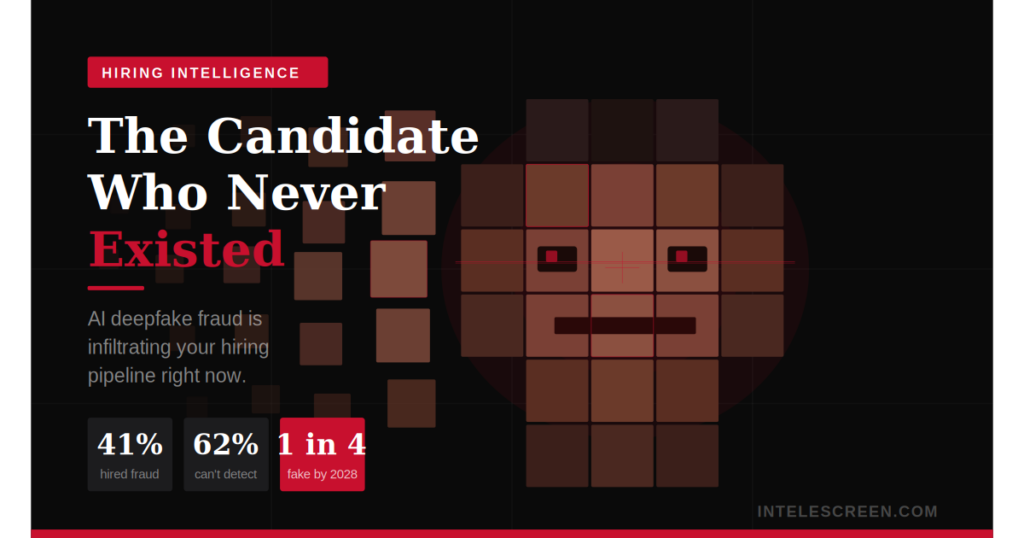
The Candidate Who Never Existed
AI-generated faces, cloned voices, and synthetic identities are infiltrating your hiring pipeline right now. Here is what every HR and talent leader must know and do to stop them.
12 min read
Updated June 2026
Sits behind screen
›
Face swap · Voice clone · AI resume
›
Passes ✓
›
Passes ✓
›
?
How a synthetic candidate moves through your pipeline undetected
The person who aced your video interview may never show up on day one
Think back to your last round of video interviews. A confident, articulate candidate. Spotless resume. Verified credentials. Glowing references. You extended an offer. Then on day one — a completely different person walked through the door.
Welcome to the era of the deepfake candidate. This is not science fiction, and it is not a problem confined to tech firms. It is happening across every sector and every level of seniority. According to a 2025 survey by Checkr, 41 percent of IT, cybersecurity, risk, and fraud leaders confirmed their organisation had hired and onboarded a fraudulent candidate. Gartner projects that by 2028, one in four candidate profiles worldwide will be synthetic.
“We are not talking about a padded resume. We are talking about a fully constructed human being — face, voice, history, references — that never existed.”
— InteleScreen Research Team, June 2026
The technology enabling this deception has become disturbingly accessible. Real-time face-swap tools overlay a synthetic face onto a live video call. Voice cloning requires just minutes of audio. Large language models generate hundreds of keyword-optimised, role-specific resumes in minutes. For a bad actor, the barrier to fraud has essentially collapsed.
The scale of the problem: what the data tells us
Four ways fraudsters are infiltrating your pipeline
Understanding how hiring fraud actually operates is the foundation of any effective defence. These are the four attack vectors talent acquisition teams face in 2026.
AI-generated resumes
Large language models produce dozens of polished, keyword-optimised CVs tailored to any job description in minutes. They are indistinguishable from authentic documents and flood applicant tracking systems with synthetic profiles. 72 percent of hiring professionals have already encountered them.
Real-time face-swap interviews
Using tools that overlay a synthetic face onto a live video call, an impostor can impersonate another person in real time. The AI handles the visual transformation while the fraudster conducts the interview behind the mask. 15 percent of hiring managers have already encountered this.
Proxy interview networks
Underground networks openly trade interview fraud services. A skilled proxy takes the interview on behalf of the actual candidate, guided by a hidden coach via live transcription tools. One in three hiring managers has discovered a candidate using proxy impersonation.
Fully synthetic identities
The most sophisticated schemes involve entirely fictional people — AI-generated headshots, fabricated work histories, and fake LinkedIn profiles with synthetic endorsements. These identities are engineered to pass standard background checks and persist undetected for months post-hire.
When fraud makes it all the way through
It is tempting to treat these risks as theoretical. They are not.
KnowBe4: The North Korean inside the IT team
Cybersecurity firm KnowBe4 discovered in 2024 that a North Korean state operative had been hired using a stolen identity and an AI-doctored photograph. The individual passed multiple rounds of structured interviews and cleared a conventional background check before attempting to install malware on company systems post-onboarding. The fraud was detected not by the hiring process — but by anomalous behaviour flagged by internal security monitoring. The hiring process had generated complete false confidence throughout.
Infosys: The proxy who couldn’t do the job
Infosys discovered early in 2025 that a hired candidate had used proxy impersonation throughout every interview stage. The fraud lasted just 15 days post-hire before the dramatic gap between interview performance and actual work output made it impossible to ignore. By that point the damage to project timelines, team dynamics, and internal trust had already been done. Even rapid detection carries a real cost.
The true cost of a fraudulent hire
The financial exposure from a single fraudulent hire is far larger than most organisations account for in their risk models.
| Cost Category | Description | Estimated Range |
|---|---|---|
| Investigation costs | Forensic review, legal counsel, internal investigation time | $15,000 – $25,000 |
| Direct annual losses | 23% of companies lose over $50K per year from fraudulent hires | $50,000 – $100,000+ |
| Productivity impact | Bad hire reduces team output during detection and transition | 20–30% reduction |
| Project delays | Missed deliverables while replacing the fraudulent hire | Weeks to months |
| Reputational damage | Employer brand erosion, client trust impact, security incidents | Difficult to quantify |
Eight strategies to protect your hiring process now
A layered defence, implemented thoughtfully, can dramatically reduce your exposure. None of these steps require rebuilding your entire talent acquisition function.
Deploy AI-powered identity verification at application stage
Modern verification platforms use liveness detection, biometric analysis, and document authentication to catch synthetic media in real time — before a fraudster ever reaches your interview stage. Only 31 percent of organisations currently use this technology.
Introduce multi-point authentication throughout the full hiring journey
A single video interview checkpoint is not sufficient. Build verification touchpoints at every stage. Forcing a fraudster to maintain a synthetic persona across multiple formats makes consistent deception exponentially harder.
Train interviewers to recognise deepfake artefacts
Train your team to watch for: unnatural blinking patterns, audio-visual sync delays, lighting inconsistencies around the hairline, and unnaturally smooth skin texture. Ask candidates to turn their head or move their hand across their face — actions that commonly break face-swap algorithms.
Make your interviews structurally hostile to proxies
Replace scripted interviews with spontaneous follow-up questions, live problem-solving exercises, and highly specific probes into past projects that only a genuine expert could answer convincingly.
Integrate AI screening platforms with built-in fraud detection
InteleScreen’s Spectra platform embeds fraud detection directly into the interview workflow — cross-referencing candidate data, flagging inconsistencies, and validating authenticity through real-time behavioural analysis integrated with Microsoft Teams.
Reintroduce in-person touchpoints for critical roles
Google, McKinsey, and a growing list of major employers have reintroduced mandatory in-person verification steps specifically in response to AI interview fraud. For roles involving sensitive data or financial systems, at least one in-person assessment before an offer is now best practice.
Strengthen the first 90 days with structured performance monitoring
Build structured 30-60-90 day checkpoints that directly compare interview performance to actual work output. A dramatic gap between demonstrated capability in the interview room and real-world delivery is the primary early indicator of fraud.
Build and rehearse a fraud incident response protocol
When fraud is detected — and it will be — you need a pre-defined response plan covering containment, forensic documentation, notification protocols, and post-incident review. Having a protocol transforms a crisis from a chaotic scramble into a managed, recoverable event.
The arms race will intensify. Build your defence now.
The same AI that enables candidate fraud is also the most effective weapon against it. Advanced deepfake detection systems now analyse micro-expressions, blood flow patterns visible through skin pigmentation, and audio spectral characteristics to identify synthetic media with accuracy rates exceeding 95 percent. That capability is being embedded directly into recruitment platforms today.
“70 percent of managers now view hiring fraud as an underestimated financial risk requiring leadership-level attention. The question is no longer whether to act — it is how quickly.”
— InteleScreen Intelligence Briefing, 2026
The deepfake candidates are already here. The only question remaining is whether your hiring process is built to catch them.
Sources & References
- Checkr — The Hiring Hoax: What 3,000 Managers Revealed about Hiring Fraud, 2025
- Gartner — Top Trends for Talent Acquisition in 2026, October 2025
- Federal Trade Commission — Job Scam Losses Report, 2024
- CBS News — AI-Driven Deepfake Fraud in Business Survey, 2025
- InCruiter — Deepfake Detection Technology Launch Findings, 2026
- KnowBe4 — North Korean Hacker Incident Report, 2024
- Biometric Update — Deepfake Candidates and AI Resumes in Hiring Processes, 2025

Is your hiring process
ready for what’s coming?
InteleScreen’s Spectra platform detects impersonation, proxy interviews, and deepfake risk in real time — integrated directly with Microsoft Teams.